

Tallahassee, FL Dental Implants
Dental Implants in Tallahassee, FL
When a tooth cannot be restored, an implant is an excellent way to replace it. Rather than resting on the teeth either side, an implant replaces the root itself: a small titanium post goes into the bone where the tooth used to be, the bone grows tightly around it, and a crown is fitted on top. What you end up with stays in your mouth, is cleaned like a natural tooth, and is not going anywhere when you eat.
Implant work is placed here rather than referred out. Dr. David W. Gemmell has more than ten years of advanced practice and over 10,000 implants behind him, so the planning, the placement and the crown that finishes the job all happen with the same team, in the same building, using the same records.
Missing a tooth, or facing an extraction and wondering what comes after it? Call 850-404-7462 and we will talk you through what your options would actually involve.
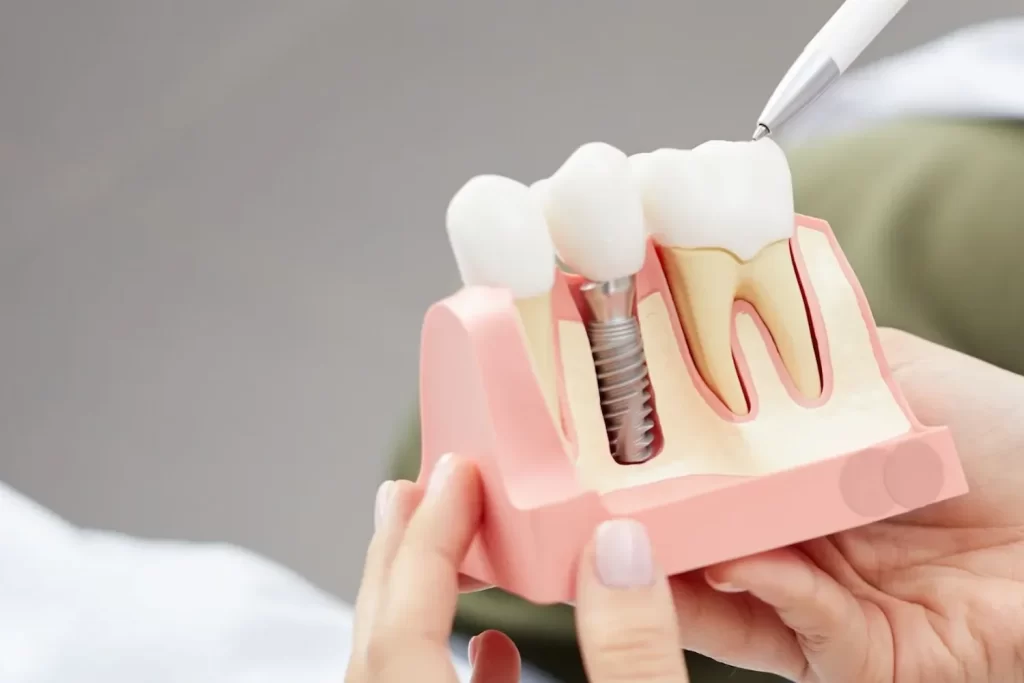
What an Implant Is Made Of
Patients often picture a single artificial tooth. It is really three components, and knowing which is which makes the rest of this page easier to follow — and the quotes easier to read.
- The Implant — a titanium post, a few millimeters across, placed in the jawbone in the position of the old root. Bone bonds directly to its surface over the following months, which is what makes it stable.
- The Abutment — the connector that sits on top of the post and passes through the gum. It is what the crown attaches to.
- The Crown — the visible tooth, made in ceramic and matched to the teeth on either side of the gap.
The same post can carry more than one tooth: two implants can support a bridge across a longer gap, and a small number of them can hold a full denture firmly in place instead of it relying on suction. Which of those suits you is a conversation about how many teeth are missing, where, and how much bone is there to work with.
The Implant Timeline
-
Consultation and Imaging
We look at the gap, the teeth around it and the bone underneath it on an x-ray, and check that your gums are healthy enough to support the work. You leave with a written plan: how many implants, whether any groundwork is needed first, roughly how long it will take and what each stage costs.
-
Groundwork, If It Is Needed
Sometimes the tooth is still there and has to come out. Sometimes a tooth has been missing for years and the bone that held it has thinned, in which case a graft rebuilds enough width or height for a post to be anchored properly. Not everyone needs this stage; those who do are better served by it than by an implant placed in bone that cannot hold it.
-
Placing the Implant
The post goes in under local anesthetic, in an appointment shorter than most people expect. Patients routinely tell us afterwards that it was less of an ordeal than the extraction had been. You go home the same day with aftercare instructions and something for the soreness of the following day or two.
-
Healing
This is the long part, and it is the one that cannot be rushed: bone grows onto the implant surface over roughly three to six months. Nothing is happening that you can feel, and you carry on normally — where the gap shows when you smile, a temporary tooth covers it in the meantime.
-
The Crown
Once the implant is solid, the abutment and crown are fitted, shaped and matched, and your bite is adjusted so the new tooth takes its fair share of the load and no more. From that day it is yours to brush and floss like any other tooth.
Implant, Bridge or Denture?
An implant is not the only way to replace a missing tooth, and it is not automatically the right one. Here is the honest comparison we would give you in the chair:
- Implant — the longest-lasting option and the only one that preserves the bone where the tooth was, because the post loads that bone the way a root did. The teeth either side are left untouched. It costs more up front and takes months rather than weeks.
- Bridge — faster and cheaper, with the replacement tooth carried by crowns on the teeth either side. Those two teeth have to be prepared for crowns, which is a real cost when they are otherwise healthy, and the bone under the gap continues to shrink.
- Denture — the least expensive answer and the quickest, and sometimes the only practical one when several teeth are gone. It is removable, it takes getting used to, and it does not stop the ridge beneath it resorbing over the years.
- Leaving the Gap — reasonable for a back molar in some cases, and worth discussing rather than assuming. Be aware that neighboring teeth tilt into a gap over time and the opposing tooth drifts down towards it, which can create problems of its own.
Tell us what matters most — the cost, the timeline, avoiding surgery, never taking anything out at night — and we will tell you which option that points to.
Frequently Asked Questions Dental Implants in Tallahassee, FL
The placement itself is done under local anesthetic and is not painful — bone has no nerve endings of the kind that register that sort of work, and most patients describe pressure rather than pain.
Afterwards, expect soreness and some swelling for a couple of days, similar to having a tooth out and usually managed with ordinary pain relief. If you are anxious about the surgery, say so at the consultation; that is a normal thing to be anxious about and there are ways to make it easier.
Three to six months from placement to crown in a straightforward case. Add a couple of months if a tooth has to be extracted first and the site allowed to heal, and more again if a bone graft is needed.
Very little of that is time in the chair — it is waiting for bone to fuse to the implant, which is exactly what makes the result last. You are not toothless during it: where the gap is visible, a temporary covers it.
The post itself can last decades and often a lifetime, provided the gum and bone around it stay healthy. The crown on top is the part that wears like any other restoration and may need replacing at some point along the way.
What threatens an implant is not decay — titanium and ceramic do not rot — but infection of the tissue around it, which behaves much like gum disease. Brushing, flossing around the implant and keeping your check-ups are what protect the investment.
Age on its own rules nobody out; we place implants for patients in their seventies and eighties. What matters is general health, healthy gums, and enough bone — and where bone is lacking, grafting often solves it.
Some things do need managing first: active gum disease, uncontrolled diabetes, certain medications affecting bone, and smoking, which measurably raises the failure rate. We will tell you honestly if you are not a good candidate rather than take the work on and hope.
Sometimes not, and we will say so. If the gap is at the very back and your bite is stable, leaving it can be a perfectly sensible decision.
What we would not want you to do is assume that, because a gap does not show, nothing is happening. Teeth beside a gap tilt into it and the tooth above drifts down, which makes cleaning harder and can change how your bite loads for years afterwards. It is worth a proper look before deciding either way.
It depends on the stages your case needs — extraction, grafting, the implant, the abutment and the crown are separate items, and not every case includes all of them. Your written plan prices each one, so nothing arrives as a surprise.
Dental plans vary widely here: some contribute to part of the treatment, often the crown, while others exclude implants entirely. We are in-network with most PPO providers, we will check your benefits before you commit, and our membership plan takes 20% off for patients without coverage. Financing that spreads the cost over monthly payments is also available — ask us and we will explain how it works.